Monday, August 2, 2010
Experts: AnselAdams photos found at garage sale worth $200 million

Tuesday, July 27, 2010
'Oldest' images of Christ's apostles found in Rome

Restorers used new laser technology to uncover the images
Reprinted from 22 June 2010 - BBC Mobile News Europe
Art restorers in Italy have discovered what are believed to be the oldest paintings of some of Jesus Christ's apostles.
The faces of Apostles Andrew, John, Peter and Paul were uncovered using new laser technology in a catacomb in Rome.
The paintings date from the second half of the 4th Century or the early 5th Century, the restorers and Vatican officials believe.
The images may have influenced later depictions of Christ's early followers.
'Very emotional'"These are the first images that we know of the faces of these four apostles," said Fabrizio Bisconti, head of archaeology for Rome's numerous Vatican-owned catacombs.
“Start Quote
Barbara MazzeiProject leaderIt was very, very emotional to discover this”
The frescoes in a tomb of a Roman noblewoman in the Santa Tecla catacomb were known about but their details came to light during a two-year restoration project funded by the Vatican.
The images were uncovered using new laser technology that allowed the restorers to burn off thick white calcium carbonate deposits caused by extreme humidity and lack of air.
"The laser created a sort of mini-explosion of steam when it interacted with the calcium carbonate to make it detach from the surface," said Barbara Mazzei, who was in charge of the project.
"It was very, very emotional to discover this," she added.
Andrew, Peter and John were among Jesus' original 12 apostles.
Paul was an influential early Christian who travelled widely in the Mediterranean area in the 1st Century. His letters to the early churches, found in the Bible's New Testament, are arguably some of the most influential on Christian thinking.
Monday, July 26, 2010
I KNEW IT! Vatican Reverses Itself, "The Martyrdom of St. Lawrence" Not a Caravaggio
The head of the Vatican Museums, Antonio Paolucci, wrote in the Vatican newspaper L'Osservatore Romano that the work was most likely a copy of an original by a Caravaggio-influence artist.
It was L'Osservatore itself that set the art world aflutter last week with a front-page article headlined "A New Caravaggio," detailing the artistry behind the "Martyrdom of St. Lawrence," which had been discovered in the sacristy of a Jesuit church in Rome.
The author of the article, art historian Lydia Salviucci Insolera, had made clear that she was not making any conclusions about the authenticity of the work and that more diagnostic tests were required.
But the impression given by the newspaper was that the painting was indeed a never-before-seen Caravaggio: The definitive-sounding headline appeared above the fold alongside a color photograph of the dramatic painting — on the 400th anniversary to the day of the master's death.
The Vatican has in the past announced such art-world news in L'Osservatore, such as when it revealed last year that the earliest known icon of St. Paul had been discovered in a Roman catacomb just in time for the saint's feast day.
The original Caravaggio article published June 18 pointed out that the "The Martyrdom of St. Lawrence" presented features typical of the artist's style, such as the use of chiaroscuro for dramatic effect and the unique perspective from which the subject is seen. The report also highlighted similarities with other Caravaggio's paintings, for example in the saint's hand and body movement.
But on Monday, after a week of "Caravaggiomania" that ensued amid the already frenzied Caravaggio anniversary celebrations in Italy, Vatican Museum chief Paolucci, a former Italian Culture Minister, issued the equivalent of a Holy See mea culpa and reversal.
In a front-page article entitled "A New Caravaggio? Not really" Paolucci wrote that the work was not of Caravaggio's quality and termed it "modest" at best, pointing out in particular that the hands were completely out of perspective.
The painting depicts a semi-naked young man, his mouth open in desperation, one arm stretched out as he leans over amid flames. St. Lawrence was burned to death in 258.
Paolucci said that while the idea of putting St. Lawrence on the grill where he became a martyr was dramatically beautiful, and the thugs perpetrating his martyrdom are suggestive of Caravaggio's themes, a closer look reveals stylistic shortcomings.
He said that the hands are "wrong in their perspective," that the subjects' anatomies were "awkward" and that — in the case of nudes in the background — "disjointedPaolucci also noted that the painting technique was "inadequate."
"The quality isn't there, whereas in a Caravaggio it always is, and it's high even when ... he uses maximum carelessness and a minimum of his expressive resources," Paolucci wrote.
He stressed that he wasn't criticizing Insolera and noted that she had correctly made clear that further analysis and documentation would be required to provide definitive answers as to whether the work was a Caravaggio.
The painting is to be unveiled to the public on Tuesday by Italy's Culture Ministry.
At the time of the discovery, Maurizio Marini, a leading Caravaggio scholar, expressed doubts about the authenticity of the work in an interview with The Associated Press. He concurred with Insonlera who noted that St. Lawrence was not a known Caravaggio subject. And he said the stylistic similarities were inconclusive and that claims of new Caravaggios often surface but seldom hold up.
Caravaggio died in the Tuscan coast town of Porto Ercole in 1610 at age 39 under mysterious circumstances. He had been hugely influential and famous, but had also led a dissolute life of street brawls and alcohol.
Recently, a team of Italian researchers said they had identified Caravaggio's remains after a year of digging up bones in Porto Ercole and conducting carbon dating, DNA testing and other analyses.
Italy has been marking the anniversary with a variety of events, and an exhibit in Rome earlier this year drew over half a million visitors.
___
Associated Press reporter Alessandra Rizzo contributed to this report.
Copyright 2010 The Associated Press.
Wednesday, July 21, 2010
400 years after his death, Caravaggio work is found
The martyrdom of St Lawrence in a newly discovered painting thought to be by CaravaggioArt experts in Rome are analysing what they believe is a previously unknown painting by the Italian Baroque master Caravaggio.
As his homeland marked the 400th anniversary of his death this weekend, the Vatican's official newspaper L'Osservatore Romano published the newly discovered work on its front page. Depicting the martyrdom of St Lawrence, it was found recently among the possessions of the Society of Jesuits in Rome. It shows a semi-naked young man, his mouth open in desperation with one arm stretched out as he leans over flames. If the suspected provenance is confirmed, it would be the first painting by the Baroque genius to emerge since The Calling of Saints Peter and Andrew, which went on display two years ago.
"What is certain is that we're dealing with a stylistically impeccable, beautiful painting," said the art historian Lydia Salviucci Insolera. "Particularly notable is the light that leaps from the areas of darkness to reveal the surface volume in sudden flashes."
Caravaggio, born Michelangelo Merisi, is celebrated for his revolutionary use of contrasting light and dark -– chiaroscuro – which anticipated the work of later Baroque giants including Rembrandt and Velázquez.
The art historian cautioned that experts should be careful to avoid the trap of labelling it a Caravaggio "at all costs" at a time when interest in the revolutionary painter was at an all-time high, saying that further analysis and research would be needed.
Another Caravaggio expert, Maurizio Marini, was sceptical about the provenance of the painting in question, noting that St Lawrence, a martyr burned to death during Roman persecutions in 258AD, was not a known Caravaggio subject.
Ms Salviucci Insolera noted, however, there was evidence that Caravaggio came into contact with powerful Crescenzi family, the patrons of Jesuit art in Rome during the period. And she added: "That the painting is truly beautiful is unarguable. And that it is at the very least a Caravaggio-esque work of the highest order is quite obvious."
The Vatican newspaper did not reveal where the painting is being analysed or by whom. But the news added to the Caravaggio fever gripping Italy this weekend, with galleries and churches staying open all night to let as many aficionados as possible admire his works.
"This is a fitting event for someone whose works used night as a backdrop," said Rossella Vodret, the museums superintendent in Rome, where fans flocked to the Borghese Gallery and three churches on Saturday night, despite the sweltering conditions. The five famous Caravaggio paintings in the Borghese have been joined for a current hit show by four masterpieces from three other top Roman galleries: Judith Beheading Holofernes; Narcissus; and two of his eight John the Baptist paintings.
Caravaggio festivities kicked off in February with a blockbuster show of 24 of his greatest paintings at the Scuderie Del Quirinale in Rome. The event drew more than half a million visitors.
Interest in the mercurial artist has been raised by recent attempts to shed light on the mystery surrounding his death on 18 July 1619 at the age of 38. The investigation, involving DNA tests and comparisons with living relatives, concluded that the painter was probably buried in Porto Ercole, in Tuscany, after suffering an illness, thereby bringing centuries of speculation, including assassination theories, to an end.
Caravaggio was active in Rome, Naples, Malta and Sicily. But he often had to flee cities and leave works because of his tempestuous nature, which led him to kill at least one man.
*******
JILL'S NOTE: It's impossible to evaluate whether or not this is a genuine Caravaggio without seeing the original painting, reviewing the testing done on the work, reading the scholarship devoted to the painting, and analyzing any other documentation related to the provenance of the work. My gut reaction is that I do not find the photograph at all convincing. To my eyes, this appears to be the work of a follower of Caravaggio, rather than by the artist himself. The lighting and tone transitions are harsh and imitative. Caravaggio was a master of subtle lighting and of tenebrism (a style he developed). Nevertheless, this painting is an exciting discovery.
Friday, July 16, 2010
French scientists crack secrets of Mona Lisa

AP – This recent undated photo provided Friday July 23, 2010, by the CNRS (National Center of Scientific Research) …
By ANGELA DOLAND, Associated Press Writer
PARIS – The enigmatic smile remains a mystery, but French scientists say they have cracked a few secrets of the "Mona Lisa."
French researchers studied seven of the Louvre Museum's Leonardo da Vinci paintings, including the "Mona Lisa," to analyze the master's use of successive ultrathin layers of paint and glaze — a technique that gave his works their dreamy quality.
Specialists from the Center for Research and Restoration of the Museums of France found that da Vinci painted up to 30 layers of paint on his works to meet his standards of subtlety. Added up, all the layers are less than 40 micrometers, or about half the thickness of a human hair, researcher Philippe Walter said Friday
The technique, called "sfumato," allowed da Vinci to give outlines and contours a hazy quality and create an illusion of depth and shadow. His use of the technique is well-known, but scientific study on it has been limited because tests often required samples from the paintings.
The French researchers used a noninvasive technique called X-ray fluorescence spectroscopy to study the paint layers and their chemical composition.
They brought their specially developed high-tech tool into the museum when it was closed and studied the portraits' faces, which are emblematic of sfumato. The project was developed in collaboration with the European Synchrotron Radiation Facility in Grenoble.
The tool is so precise that "now we can find out the mix of pigments used by the artist for each coat of paint," Walter told The Associated Press. "And that's very, very important for understanding the technique."
The analysis of the various paintings also shows da Vinci was constantly trying out new methods, Walter said. In the "Mona Lisa," da Vinci used manganese oxide in his shadings. In others, he used copper. Often he used glazes, but not always.
The results were published Wednesday in Angewandte Chemie International Edition, a chemistry journal.
Tradition holds that the "Mona Lisa" is a painting of Lisa Gherardini, wife of Florentine merchant Francesco del Giocondo, and that da Vinci started painting it in 1503. Giorgio Vasari, a 16th-century painter and biographer of da Vinci and other artists, wrote that the perfectionist da Vinci worked on it for four years.
Thursday, July 15, 2010
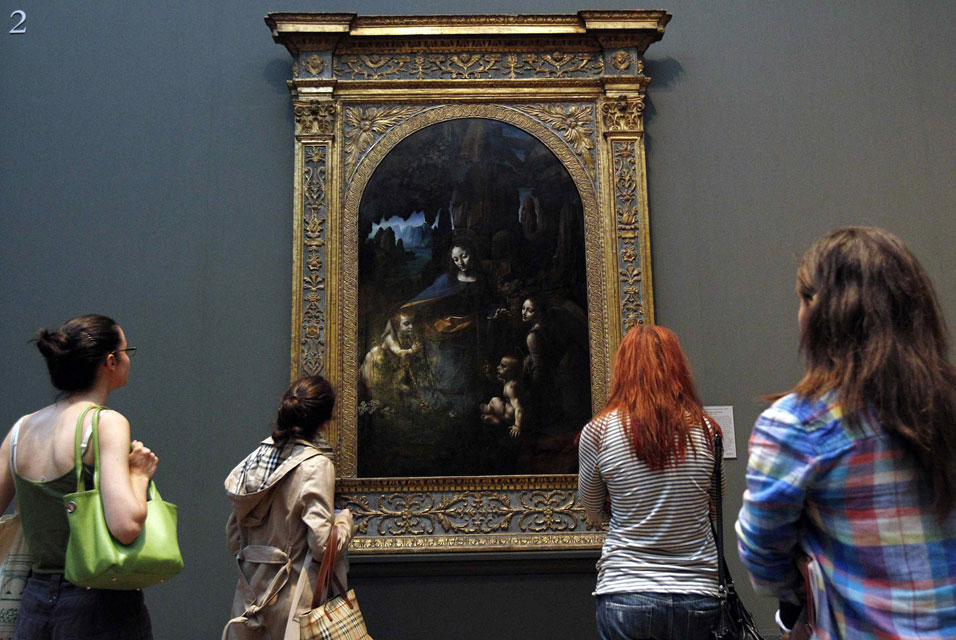
Restored Leonardo Masterpiece Goes Back on Display at the National Gallery in London


The Virgin Mary is seen from the artwork "The Virgin on the Rocks" by Leonardo da Vinci (1491-1508), at the National Gallery in London July 14, 2010. An 18-month project to restore Leonardo da Vinci's "Virgin of the Rocks" revealed the Renaissance artist likely painted the entire work himself rather than, as previously thought, with the help of his assistants. REUTERS/Suzanne Plunkett.
The decision to restore the painting came after several years of intensive study of Leonardo’s work and that of his Milanese associates and assistants – the so-called leonardeschi – from within the Gallery’s collection. The experience gained from examining these pictures reinforced the view that 'The Virgin of the Rocks' could not be appreciated as originally intended. The cleaning process began because some varnish that was applied in 1948–9 was particularly unstable and prone to yellowing. Fine cracking in that varnish, and atmospheric dirt which had become absorbed in its waxy surface, meant that the ability of the varnish to fully saturate the picture had become seriously compromised. As a result the subtlety of shading and the sense of space were markedly reduced, and the impact of this great work significantly lessened.
The conservation involved removing much of the badly degraded varnish from the painting, though leaving a very thin layer over most of the picture surface. While the cleaning did not effect a dramatic shift of colour, it produced a significant improvement in saturation which has allowed a much greater appreciation of the painting’s full tonal range, especially in the darker areas. This has in turn given a much clearer sense of the unified lighting, three-dimensional modelling and the intended spatial recession through the rocky landscape.
The restoration was undertaken by Larry Keith, the new Director of Conservation, working in collaboration with the picture’s curator, Luke Syson, and the Scientific Department, under the direction of Ashok Roy. There were also discussions and exchanges with colleagues from several other institutions in Europe and America, including the Louvre, which has an extensive Leonardo collection that includes the earlier version of 'The Virgin of the Rocks'.
The conservation and associated technical research has reaffirmed the sense that the picture is not finished in the traditional sense, and instead shows a range of completion from the level of the barely sketched hand of the angel to the fully realised heads of the principal figures. The associated study of materials and techniques has also been an important element of a more comprehensive reappraisal of the picture’s genesis and authorship. In the past, Gallery curators, like many scholars of Renaissance painting elsewhere, have explained the different levels of finish and resolution in the picture by arguing that Leonardo was helped by assistants in realising this second version of the composition; it now seems possible that Leonardo painted all the picture himself, leaving some parts just sketched or yet to be completely resolved, and others (such as the angel’s head) fully worked up.
'The Virgin of the Rocks' will be displayed in a new frame made by Peter Schade, Head of Framing at the Gallery. This incorporates parts – the pilasters and cornice – of a north Italian frame of about 1500, purchased specially in Italy in 2009. Schade has added the missing elements, referring to carved frames executed by Giacomo Del Maino who carved the altarpiece into which 'The Virgin of the Rocks' was originally set. This new frame will therefore evoke the gilded setting of Leonardo’s masterpiece, accentuating its muted colour scheme, the artist’s revolutionary system of shadowing and the elements of his pictorial ‘relief’, already made so much more evident by the restoration. Newly cleaned and framed in this way, the Virgin’s left hand, for example, now seems to project into the viewer’s space.
The restoration process has provided the opportunity for a comprehensive study of 'The Virgin of the Rocks' by the National Gallery’s Scientific, Conservation and Curatorial departments, with the findings being published online in the National Gallery’s Technical Bulletin in September 2011. The Gallery will expand its initial research on Leonardo himself to include the systematic investigation of Leonardo’s Milanese pupils, collaborators and followers. (Reprinted from ArtDaily.org - July 15, 2010)
Sunday, July 11, 2010
The Magic of Miró

Joan Miró - Spanish, 1893 - 1983 - Shooting Star - 1938 - oil on canvas - Overall: 65.2 x 54.4 cm (25 11/16 x 21 7/16 in.) framed: 87 x 77.4 x 5.7 cm (34 1/4 x 30 1/2 x 2 1/4 in.) Gift of Joseph H. Hazen - National Gallery of Art - Washington, D.C.