Friday, July 16, 2010

French scientists crack secrets of Mona Lisa

AP – This recent undated photo provided Friday July 23, 2010, by the CNRS (National Center of Scientific Research) …

By ANGELA DOLAND, Associated Press Writer

PARIS – The enigmatic smile remains a mystery, but French scientists say they have cracked a few secrets of the "Mona Lisa."

French researchers studied seven of the Louvre Museum's Leonardo da Vinci paintings, including the "Mona Lisa," to analyze the master's use of successive ultrathin layers of paint and glaze — a technique that gave his works their dreamy quality.

Specialists from the Center for Research and Restoration of the Museums of France found that da Vinci painted up to 30 layers of paint on his works to meet his standards of subtlety. Added up, all the layers are less than 40 micrometers, or about half the thickness of a human hair, researcher Philippe Walter said Friday

The technique, called "sfumato," allowed da Vinci to give outlines and contours a hazy quality and create an illusion of depth and shadow. His use of the technique is well-known, but scientific study on it has been limited because tests often required samples from the paintings.

The French researchers used a noninvasive technique called X-ray fluorescence spectroscopy to study the paint layers and their chemical composition.

They brought their specially developed high-tech tool into the museum when it was closed and studied the portraits' faces, which are emblematic of sfumato. The project was developed in collaboration with the European Synchrotron Radiation Facility in Grenoble.

The tool is so precise that "now we can find out the mix of pigments used by the artist for each coat of paint," Walter told The Associated Press. "And that's very, very important for understanding the technique."

The analysis of the various paintings also shows da Vinci was constantly trying out new methods, Walter said. In the "Mona Lisa," da Vinci used manganese oxide in his shadings. In others, he used copper. Often he used glazes, but not always.

The results were published Wednesday in Angewandte Chemie International Edition, a chemistry journal.

Tradition holds that the "Mona Lisa" is a painting of Lisa Gherardini, wife of Florentine merchant Francesco del Giocondo, and that da Vinci started painting it in 1503. Giorgio Vasari, a 16th-century painter and biographer of da Vinci and other artists, wrote that the perfectionist da Vinci worked on it for four years.

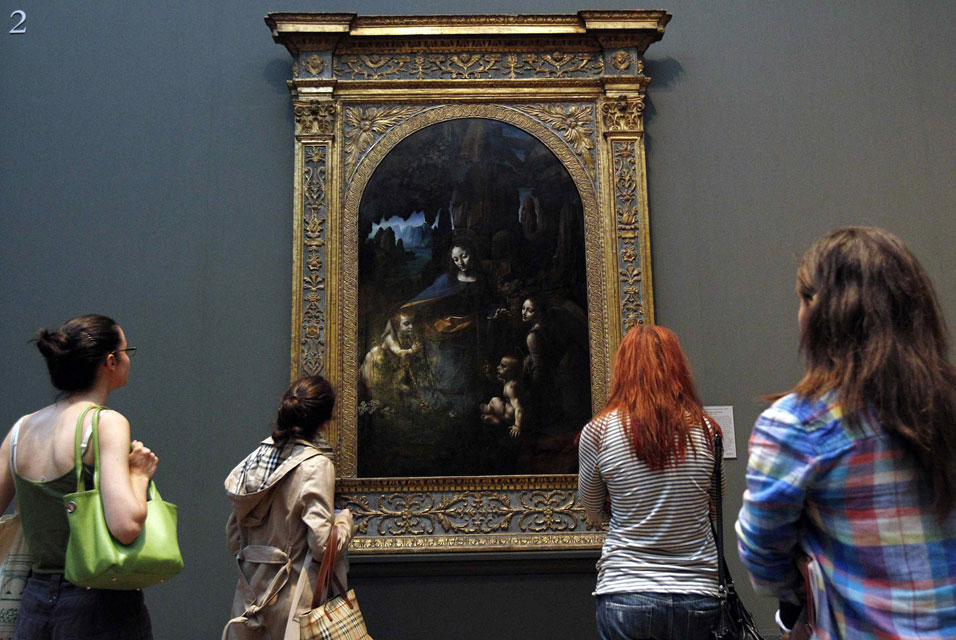
Thursday, July 15, 2010

Restored Leonardo Masterpiece Goes Back on Display at the National Gallery in London


The Virgin Mary is seen from the artwork "The Virgin on the Rocks" by Leonardo da Vinci (1491-1508), at the National Gallery in London July 14, 2010. An 18-month project to restore Leonardo da Vinci's "Virgin of the Rocks" revealed the Renaissance artist likely painted the entire work himself rather than, as previously thought, with the help of his assistants. REUTERS/Suzanne Plunkett.

LONDON.- Leonardo da Vinci’s Virgin of the Rocks is to go back on display in the National Gallery (afternoon of 14th July) after an 18-month restoration project which started in November 2008.

The decision to restore the painting came after several years of intensive study of Leonardo’s work and that of his Milanese associates and assistants – the so-called leonardeschi – from within the Gallery’s collection. The experience gained from examining these pictures reinforced the view that 'The Virgin of the Rocks' could not be appreciated as originally intended. The cleaning process began because some varnish that was applied in 1948–9 was particularly unstable and prone to yellowing. Fine cracking in that varnish, and atmospheric dirt which had become absorbed in its waxy surface, meant that the ability of the varnish to fully saturate the picture had become seriously compromised. As a result the subtlety of shading and the sense of space were markedly reduced, and the impact of this great work significantly lessened.

The conservation involved removing much of the badly degraded varnish from the painting, though leaving a very thin layer over most of the picture surface. While the cleaning did not effect a dramatic shift of colour, it produced a significant improvement in saturation which has allowed a much greater appreciation of the painting’s full tonal range, especially in the darker areas. This has in turn given a much clearer sense of the unified lighting, three-dimensional modelling and the intended spatial recession through the rocky landscape.

The restoration was undertaken by Larry Keith, the new Director of Conservation, working in collaboration with the picture’s curator, Luke Syson, and the Scientific Department, under the direction of Ashok Roy. There were also discussions and exchanges with colleagues from several other institutions in Europe and America, including the Louvre, which has an extensive Leonardo collection that includes the earlier version of 'The Virgin of the Rocks'.

The conservation and associated technical research has reaffirmed the sense that the picture is not finished in the traditional sense, and instead shows a range of completion from the level of the barely sketched hand of the angel to the fully realised heads of the principal figures. The associated study of materials and techniques has also been an important element of a more comprehensive reappraisal of the picture’s genesis and authorship. In the past, Gallery curators, like many scholars of Renaissance painting elsewhere, have explained the different levels of finish and resolution in the picture by arguing that Leonardo was helped by assistants in realising this second version of the composition; it now seems possible that Leonardo painted all the picture himself, leaving some parts just sketched or yet to be completely resolved, and others (such as the angel’s head) fully worked up.

'The Virgin of the Rocks' will be displayed in a new frame made by Peter Schade, Head of Framing at the Gallery. This incorporates parts – the pilasters and cornice – of a north Italian frame of about 1500, purchased specially in Italy in 2009. Schade has added the missing elements, referring to carved frames executed by Giacomo Del Maino who carved the altarpiece into which 'The Virgin of the Rocks' was originally set. This new frame will therefore evoke the gilded setting of Leonardo’s masterpiece, accentuating its muted colour scheme, the artist’s revolutionary system of shadowing and the elements of his pictorial ‘relief’, already made so much more evident by the restoration. Newly cleaned and framed in this way, the Virgin’s left hand, for example, now seems to project into the viewer’s space.

The restoration process has provided the opportunity for a comprehensive study of 'The Virgin of the Rocks' by the National Gallery’s Scientific, Conservation and Curatorial departments, with the findings being published online in the National Gallery’s Technical Bulletin in September 2011. The Gallery will expand its initial research on Leonardo himself to include the systematic investigation of Leonardo’s Milanese pupils, collaborators and followers. (Reprinted from ArtDaily.org - July 15, 2010)

Sunday, July 11, 2010

The Magic of Miró


Joan Miró - Spanish, 1893 - 1983 - Shooting Star - 1938 - oil on canvas - Overall: 65.2 x 54.4 cm (25 11/16 x 21 7/16 in.) framed: 87 x 77.4 x 5.7 cm (34 1/4 x 30 1/2 x 2 1/4 in.) Gift of Joseph H. Hazen - National Gallery of Art - Washington, D.C.

Catalan painter who combined abstract art with Surrealist fantasy. His mature style evolved from the tension between his fanciful, poetic impulse and his vision of the harshness of modern life. He worked extensively in lithography and produced numerous murals, tapestries, and sculptures for public spaces.

"He was never closely aligned with any movement and was too retiring in his manner to be the object of a personality cult, like his compatriot Picasso, but the formal and technical innovations that he sustained over a very long career guaranteed his influence on 20th-century art. A pre-eminent figure in the history of abstraction and an important example to several generations of artists around the world, he remained profoundly attached to the specific circumstances and environment that shaped his art in his early years. An acute balance of sophistication and innocence and a deeply rooted conviction about the relationship between art and nature lie behind all his work and account in good measure for the wide appeal that his art has continued to exercise across many of the usual barriers of style." (SOURCE: OXFORD UNIVERSITY PRESS)


Thursday, July 8, 2010

Egyptian Archaeologists Unveil Discovery of 4,300-Year-Old Tombs with Vivid Wall Paintings


TOP - Egyptian Antiquities chief Zahi Hawass shows to the media the false door of the unearthed 4,300 year old tomb that belongs to Khonsu the son of Shendwas, both served as heads of the royal scribes during the Old Kingdom, in Saqqara near Cairo, Egypt Thursday, July 8, 2010. Egyptian archaeologists have unveiled their latest discovery, two 4,300-year-old tombs carved out of stone and unearthed in the ancient necropolis of Saqqara near Cairo. AP Photo/Nasser Nasser.

BOTTOM - View of one of two rock-hewn painted Old Kingdom tombs recently discovered at Saqqara necropolis, c. 50 km south of Cairo, Egypt, 08 July 2010. According to Dr. Zahi Hawass, Secretary General of the Supreme Council of Antiquities (SCA) and head of the excavation mission, the tombs which date to the Sixth Dynasty (2374-2191 BC), belong to a father, Shendwa, and his son, Khonsu who served as heads of the royal scribes. The burial shaft of the father's tomb is located directly beneath a false door that bears the different titles of the tomb's owner, 20 meters below the ground level. Shendwa's tomb was found intact and had not been looted but his wooden sarcophagus had disintegrated due to humidity and erosion. Among his funerary relics were found a collection of limestone jars including five offering vessels carved in the shape of a duck. EPA/KHALED EL FIQI.

By: Maggie Michael, Associated Press Writer


SAQQARA (AP).- Egyptian archaeologists on Thursday unveiled a newly-unearthed double tomb with vivid wall paintings in the ancient necropolis of Saqqara near Cairo, saying it could be the start for uncovering a vast cemetery in the area.

The tomb includes two false doors with colorful paintings depicting the two people buried there, a father and a son who served as heads of the royal scribes, said Abdel-Hakim Karar, a top archaeologist at Saqqara.

"The colors of the false door are fresh as if it was painted yesterday," Karar told reporters.

Humidity had destroyed the sarcophagus of the father, Shendwas, while the tomb of the son, Khonsu, was robbed in antiquity, he said.

Also insribed on the father's false door was the name of Pepi II, whose 90-year reign is believed to be the longest of the pharaohs. The inscription dates the double tomb to the 6th dynasty, which marked the beginning of the decline of the Old Kingdom, also known as the age of pyramids.

Egypt's antiquities chief, Zahi Hawass, said the new finds were "the most distinguished tombs ever found from the Old Kingdom," because of their "amazing colors." He said the area, if excavated, could unveil the largest cemetery of ancient Egypt.

The paintings on the false doors identified Shendwas and Khonsu as royal scribes and "supervisors of the mission," meaning they were in charge of delegations overseeing the supply of materials used for pyramids construction.

A single shaft from the surface led down to the father's tomb, from which a side passage led to that of the son, with the false door with paintings of Khonsu in front of an offering table.

Hawass pointed to a handful of duck-shaped artifacts and a small obelisk made of limestone. Such obelisks were often buried with the dead in the 5th and 6th dynasties to show their veneration for the sun god, Ra. "These artifacts were found at the end of the burial shaft, at 18 meters (yards) depth, but we covered it up," Hawass told reporters.

Karar said that so far six tombs dating back to the end of the Old Kingdom have been unearthed since digging in the area three began three years ago. Work started on the double tomb five weeks ago.

The tombs lie just west of Saqqara's most famed pyramid, the Step Pyramid of King Djoser, which is surrounded by a large burial ground, contain tombs from Egypt's earliest history up through Roman times.


Copyright 2010 The Associated Press.

Sunday, July 4, 2010

Celebrating an American Artist - Edward Hopper

Edward Hopper - House by the Railroad - 1925 - Oil on canvas - 24 x 29 in. (60.9 x 73.6 cm.)

Edward Hopper, the best-known American realist of the inter-war period, once said: 'The man's the work. Something doesn't come out of nothing.' This offers a clue to interpreting the work of an artist who was not only intensely private, but who made solitude and introspection important themes in his painting. Among the subjects he painted were hotels, motels, trains and highways. He also liked to paint the public and semi-public places where people gathered: restaurants, theatres, cinemas and offices. But even in these paintings he stressed the theme of loneliness - his theatres are often semideserted, with a few patrons waiting for the curtain to go up or the performers isolated in the fierce light of the stage. Hopper was a frequent movie-goer, and there is often a cinematic quality in his work. He transformed the concrete 'public real' into something far more personal and emotional.

"Hopper frequently used a straight. horizontal motif, usually a road or railroad track. to construct the space within the picture and to emphasize the division between the picture space and the viewer's world. Indeed, the more the viewer tries to penetrate the depths of a Hopper painting, the more impenetrable it becomes. What holds the viewer is that the artist's vision seems under control and yet, on closer inspection, the viewer realizes that the visible surface is a tissue of improbabilities and unreadable shifts in space. Hopper's view that nature and the contemporary world were incoherent contributed to his artistic vision." - From "Techniques of the Great Masters of Art"

Wednesday, June 23, 2010

Manet Sets $33.1 Million Record


View of French Impressionist Edouard Manet's Self Portrait , 1878-1879, which sold at auction at Sotheby's in London, for $33.1 Million Tuesday June 22, 2010. AP Photo/Max Nash.

LONDON (REUTERS).- Sotheby's sold an Edouard Manet self-portrait for 22.4 million pounds ($33.1 million) on Tuesday, a record for the artist but toward the lower end of pre-sale expectations of 20-30 million pounds. The painting, one of only two self-portraits by the artist and the only one in private hands, was the centerpiece of the auctioneer's main impressionist and modern art sale in London this summer. (Excerpted from eporting by Mike Collett-White; Editing by Charles Dick) Reprinted from ArtDaily - 23 June 2010

Edouard Manet broke new ground by defying traditional techniques of representation and by choosing subjects from the events and circumstances of his own time. His Déjeuner sur l’herbe (“Luncheon on the Grass”), exhibited in 1863 at the Salon des Refusés, aroused the hostility of critics and the enthusiasm of the young painters who later formed the nucleus of the Impressionist group. Manet’s debut as a painter met with a critical resistance that did not abate until near the end of his career. Although the success of his memorial exhibition and the eventual critical acceptance of the Impressionists—with whom he was loosely affiliated—raised his profile by the end of the 19th century, it was not until the 20th century that his reputation was secured by art historians and critics. Manet’s disregard for traditional modeling and perspective made a critical break with academic painting’s historical emphasis on illusionism. This flaunting of tradition and the official art establishment paved the way for the revolutionary work of the Impressionists and Post-Impressionists. Manet also influenced the path of much 19th- and 20th-century art through his choice of subject matter. His focus on modern, urban subjects—which he presented in a straightforward, almost detached manner—distinguished him still more from the standards of the Salon, which generally favored narrative and avoided the gritty realities of everyday life. Manet’s daring, unflinching approach to his painting and to the art world assured both him and his work a pivotal place in the history of modern art. Even the recognition he has finally received does not do him justice. He was a remarkable painter.

Tuesday, June 8, 2010

Spain's Cultural Ministry to Reopen Caves of Altamira Despite Scientists' Warnings


Spain's Cultural Minister Angeles Gonzalez-Sinde said Tuesday June 8, 2010 that Spain has decided to reopen a cave complex with prized prehistoric paintings after 8 years of closure, despite scientists warnings' that heat from human visitors damages the art. AP Photo/Pedro A. Saura.

MADRID (AP).- A cave complex boasting prized prehistoric paintings will reopen after eight years of closure, despite scientists' warnings that heat and moisture from human visitors damage the site known as the Sistine Chapel of Paleolithic Art. The Culture Ministry and the site's board of directors said Tuesday that visits to the Caves of Altamira in the northern Cantabria region will resume next year, although on a still-unspecified, restricted basis. The main chamber at Altamira features 21 bison painted in red and black, which appear to be charging against a low, limestone ceiling. The site was declared a UNESCO world heritage site in 1985. The paintings are estimated to be 14,000 to 20,000 years old. Discovered in 1868, the cave complex became a tourist magnet and by the 1970s received 3,000 visitors a day. Body heat and moisture from people's breath were blamed for a gradual deterioration of the images, and from 1982-2002 only a handul of visits were allowed each day. The cave was completely shut off to most visitors after scientists detected green mold stains on the paintings in the main chamber. A replica of the caves was built in a museum in 2001. In April of this year, the government's main scientific research body, called the CSIC, recommended that the caves remain closed. "The people who go in the cave have the bad habit of moving, breathing and perspiring," CSIC researcher Mariona Hernandez-Marine wrote then. The site's board voted to reopen, however, calling the caves too valuable to keep closed. "Altamira is an asset we cannot do without," the Cantabria region's president, Miguel Angel Revilla, said.

Excerpted from "Art Daily" - Copyright 2010 The Associated Press.